

When One Person Can't Let Go: Navigating Workplace Transformation
A reader asks: How do you help someone embrace positive change when their entire identity was built on workplace dysfunction?

The Question
A reader recently reached out with a scenario that’s more common than you might think:
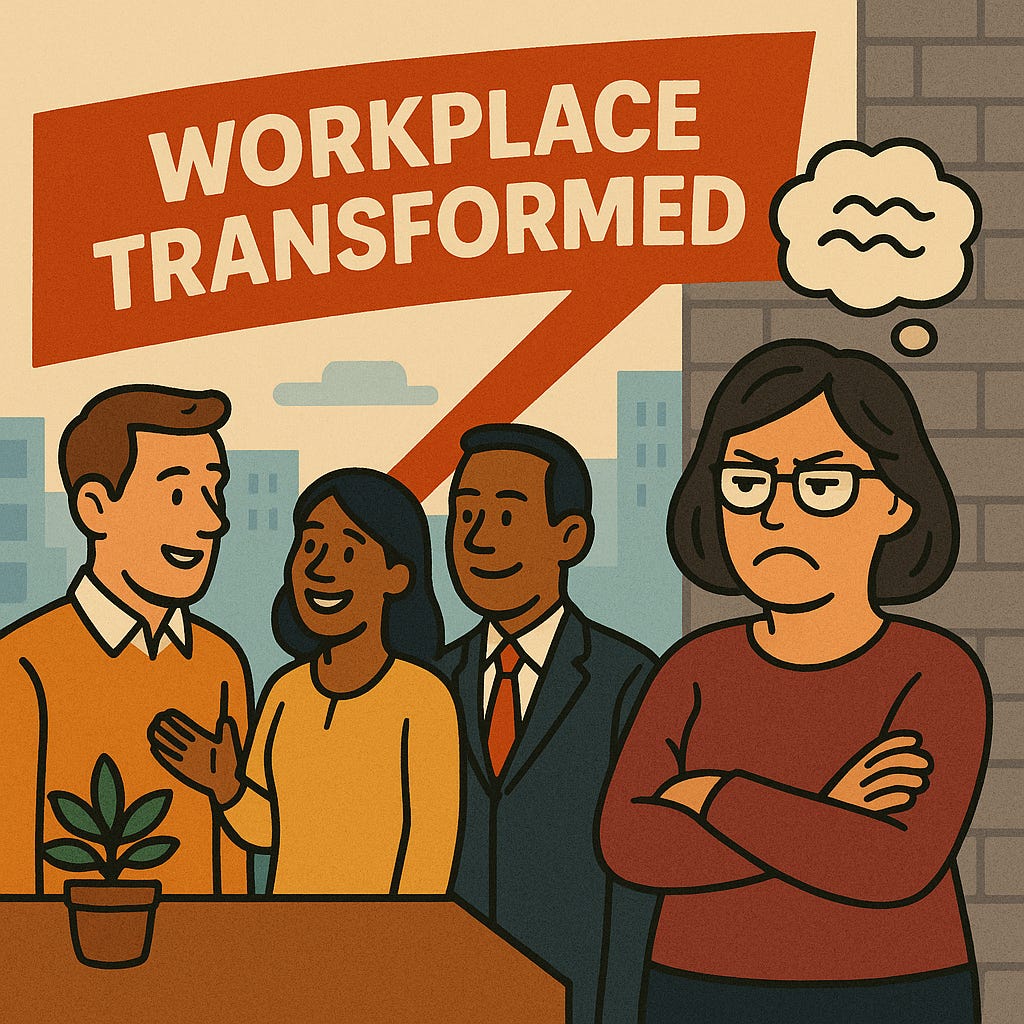
“We’ve had a major retool of our workplace and it has never been better. We have a new director and a few new managers in place, and most of the old managers have really changed how they deal with staff. My employer spent significant time and money on relationship training, and it’s working for most of us. Unfortunately, we have one manager who just won’t come around. She seems to have shut down and all she does is complain. How do we get her to realize that this workplace has changed and she’s the only one who can’t see it?”
Understanding the Psychology of Resistance
Here’s the uncomfortable truth: some people struggle to let go of the past because the past has become woven into who they are.
Let me paint a picture of this type of person. She was the hub of the gossip network. She was the manager others turned to with hushed observations: “Everyone is upset with that last decision” or “Did you hear what so-and-so did to their staff?” She was the designated confidante for complainers, the person everyone knew would spread the word—especially when told something “in confidence.”
Sound familiar?
The Identity Crisis
Here’s what’s actually happening: by transforming your workplace culture, you’ve inadvertently eliminated her role. She was the helper, the perceived “fixer,” the person with her finger on the pulse of office discontent. That was her identity, her value proposition, her reason for being essential.
Now that the workplace has genuinely improved, with fewer complaints and proper mechanisms for addressing legitimate concerns, she’s lost her purpose. Without dysfunction to navigate, without whispered grievances to collect and redistribute, she doesn’t know who she is anymore.
So what does she do? She tries to keep the water churning. She searches for problems, amplifies minor issues, and works to maintain the status quo of discontent—because that’s where she feels needed.
The Pattern You’ll Recognize
This person exhibits predictable behaviors:
Vague complaints without solutions: She’ll tell you something is wrong but offer no constructive path forward
Shutdown when ignored: She retreats when people stop engaging with her negativity
Nostalgia for “better times”: She romanticizes previous management—despite having complained about those same managers in the past
Long tenure with the organization: She often has significant history with the company, which makes her attachment to old patterns even stronger
How to Neutralize the Behavior
The key isn’t to change her mind—it’s to box in her disruptive behavior through accountability.
When she comes to you with secondhand complaints or vague concerns, respond with something like this:
“Wow, do you really think that’s happening? I’m having a hard time believing he actually said that. You need to go straight to your manager and report what you know. We’ve changed this workplace, and that type of behavior isn’t allowed. Let’s get this straightened out right away.”
I guarantee she won’t take you up on it. She’ll deflect, saying nothing will get done or that she’ll be seen as “just a complainer.”
Why? Because this type of person rarely confronts issues directly. She prefers to work behind the scenes, pulling strings, recruiting others to her cause. Once an organization shuts down triangulation, puppeteering, and gossip networks, she has nowhere to turn. And she begins to shut down.
A Word for the Disgruntled Manager
If you’re reading this and recognizing yourself, this may be difficult to hear, but it’s important: you need to let go.
If your workplace has genuinely transformed and people are happy to come to work, it’s time for some honest self-examination. Where does the real problem lie?
I understand it’s hard not to be the person you used to be. It’s difficult to feel that no one needs you the way they once did. But consider this: maybe the workplace is actually fixed. Maybe your work is done.
If you’re a long-time employee approaching retirement, perhaps it’s time to walk away—not for the company’s sake, but for your own. No one should be unhappy at work.
Maybe it’s time to hang up your skates.
The Bigger Picture
Workplace transformation is never easy, and it’s rarely universal. There will always be people who struggle to adapt, not because they’re bad people, but because change threatens their sense of identity and purpose.
The healthiest organizations recognize this dynamic and respond with both compassion and clarity: compassion for the difficult transition, but clarity about what behaviors will and won’t be tolerated moving forward.
Sometimes the kindest thing you can do for someone is to stop enabling their dysfunction—and let them decide what comes next.
What’s your experience with workplace transformation? Have you encountered someone who couldn’t let go of the old ways? Share your story in the comments.