

Why We Need Both Conservative and Progressive Thinkers in Society

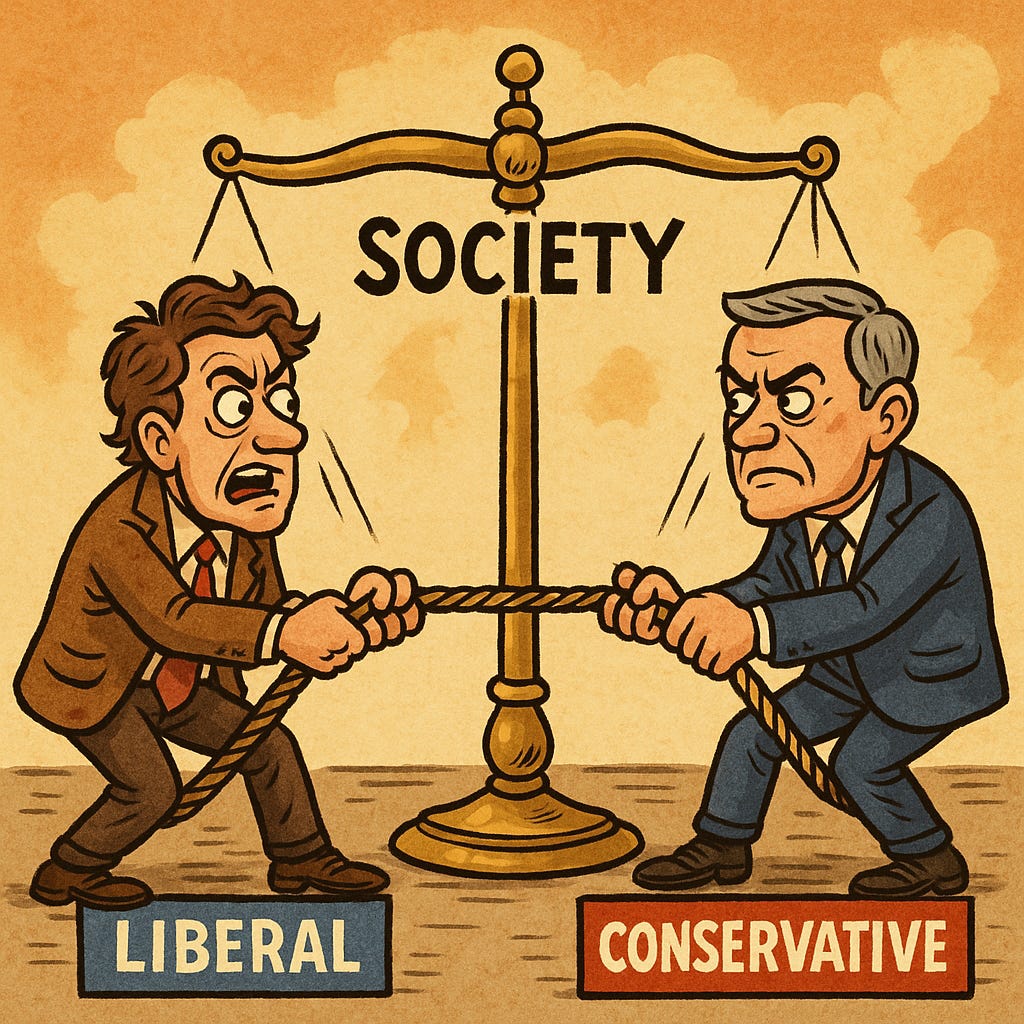
Too often today, political and social conversations turn into battles of elimination. One side pushes to silence the other, convinced that their perspective is the only legitimate one. But the truth is simpler…and more difficult. Society needs both liberal/progressive thinkers and conservative thinkers working side by side. When one side dominates, or worse, cancels the other, society suffers.
Edmund Burke, the 18th-century statesman, warned that “a state without the means of some change is without the means of its conservation.” Change is necessary to survive. Yet Burke also cautioned that change must be handled carefully, with respect for institutions and traditions. In those two thoughts - progress and caution - we find the reason why both perspectives matter.
Why We Need Conservative Voices
Conservatism is not about resisting progress for its own sake. At its best, it is about asking questions: Is this change necessary? What might we lose by moving too quickly? What unintended consequences could follow? Conservatives remind us that “new” is not automatically “better,” and that sometimes stability is just as important as momentum.
George Santayana’s famous line captures this spirit: “Those who cannot remember the past are condemned to repeat it.” Conservatives keep us grounded in history, helping prevent society from dismantling traditions or structures that still serve us well. Their voice acts as a steadying hand on the wheel, ensuring progress doesn’t outpace wisdom.
Why We Need Progressive Voices
On the other hand, progressives push society to face uncomfortable truths. They ask: Why is this tradition still in place? Does it serve everyone fairly? Can it be improved? Their energy ensures that society doesn’t become stagnant.
History shows that real improvements - civil rights, women’s suffrage, public healthcare - often began as progressive ideas. John Stuart Mill captured this value when he said, “Genuine worth and intellect are most often found on the side of the minority.” Progressive thought gives voice to those overlooked and insists on imagining a better future.
Without this push for change, we would endlessly repeat mistakes, patching up the old instead of building something better.
The Danger of Silencing One Side
But what happens when one perspective is shut down entirely? When conservatives are dismissed as outdated, or progressives are condemned as dangerous? The result is rarely peace - it is polarization.
Silencing creates fear. And fear, in turn, drives people to cling more tightly to their beliefs. When one side feels ignored or erased, its members often retreat into echo chambers where their perspectives grow sharper, louder, and sometimes more extreme.
For example, ignoring legitimate conservative concerns about stability and tradition can push people toward reactionary politics, where the goal is no longer thoughtful caution but outright resistance to all change. On the other hand, dismissing progressive calls for reform can push movements toward radicalism, where frustration builds into anger and the demand for change becomes uncompromising.
When voices are cancelled, the middle ground erodes. Instead of conversation, we get division. Instead of balance, we get extremism. Respectful engagement is the pressure valve that prevents this build-up.
The Balance Between Old and New
Neither the “old” way nor the “new” way is automatically right. The old way can provide stability, tested wisdom, and continuity. The new way can open doors to justice, innovation, and opportunity. But both have weaknesses, too. Blind loyalty to tradition can trap society in outdated systems. Blind faith in change can create chaos and unintended harm.
This is why both perspectives are needed. Progressives move us forward. Conservatives make sure we don’t leave people behind. The tension between the two isn’t a flaw - it’s the very mechanism that helps society make better decisions.
Moving Beyond “Cancel Culture”
We live in an era where cancelling or condemning opponents seems easier than engaging them. But dismissing one side doesn’t erase it. As Voltaire is often credited with saying, “I disapprove of what you say, but I will defend to the death your right to say it.” Respectful disagreement isn’t weakness - it’s strength.
Dialogue, debate, and even discomfort are how societies grow. By keeping both perspectives at the table, we ensure that change is thoughtful and stability is compassionate.
Final Thought…
Progress without caution can be reckless. Caution without progress can be paralyzing. Only by holding these perspectives together can society move forward steadily, fairly, and with lasting impact.
Conservatives ground us. Progressives drive us. And when we stop listening to either, fear fills the gap, pushing people to extremes. A healthy society doesn’t silence its differences—it embraces them as the very source of its strength.